Thursday, June 19, 2014

Summer! Rolls

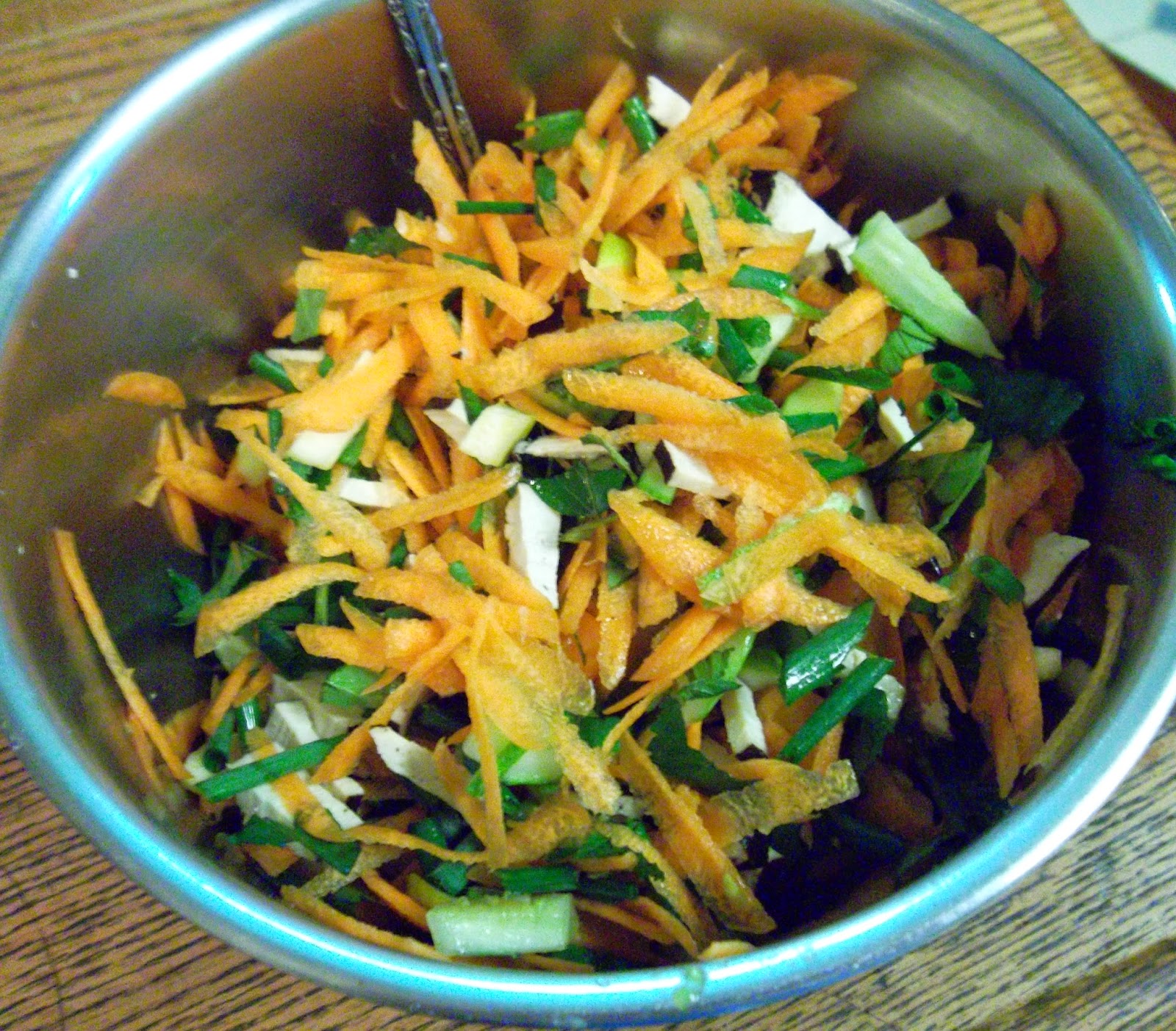
FIRST cucumbers, a tiny zucchini and 5 Sungold tomatoes + mid-90's T = Summer rolls!

 Mint, Chives & Thai Basil

With shredded carrot, tiny diced tofu
 Toss with a little S & P and olive oil
Plus rice noodles & paper
 AND don't forget the Sriracha!

This is divine.


Monday, June 16, 2014

Summer Comes

Looks like our lovely couple of weeks of rain, clouds and 70's are over. The forecast for the week is 90's and I'm seeing my first zucchini and tomatoes- sure signs of summer.
 First zucchini and
first maters- Sungold
(plant purchased from store)

Can hardly wait....

The Alpine Strawberries

Black Raspberries- my fav garden fruit
 The smaller fruits have richer flavor

Lots in bloom and bumbles
Butterflyweed and
parsnip flowers (covered in wasps, hoverflies, small bees, flies)


 Illinois Prairie Rose- a native climber
The flowers change color as they mature. The darker pink are younger and fertile- notice the pollen. The bumblebees love this rose.
 Oriental Lilies and
Hollyhocks

A new Salvia for me- Amistad
from Bowood nursery

A daylily in the Biergarten

Bumbles happy at Borage


Dill coming into flower- a self-seeder

First Nicotiana in bloom in the garden
having returned from last year's roots,
which is surprising given the hard winter.

Indian pink- Spigelia

Experiment Update
This is my biochar experiment (very unscientific with my small sample size). The California Wonder bell pepper plant on the left (control) has continued to outgrow the one on the right (biochar-treatment). The left one also has a blossom. 

Reuse, reduce, recycle
Closing shot- using an old (and broken)
ladder as a plant stand.

Happy Almost Summer

Tuesday, June 10, 2014

Weather forecast: Good for Peas, Bad for Strawberries

I've been thinking about the productivity of small scale gardens/mini-farms versus large-scale monocrops- organic or not. It seems to me the only way to have massive mono-crop farms is to depend on some kind of intervention, particularly chemical (pesticide more so than fertilizer). It would be easier to use organic fertilizer on a large scale than to go without pesticides of some kind- I think. I've read a lot of articles and books which state that small-scale farms/ gardens are more productive. In the essence of trying to be objective I've kept in mind who is writing these articles, but I have to say from my personal experience as a small gardener I can see how this could be so.

  • Having a mixed crop garden (diversity) distracts pests- food is mixed among other crops they don't eat and there isn't a lot of just one thing to overwhelm the food crop. How nature works in an ecosystem.
  • You can use small-scale interventions, like tulle or agribon, that would be more difficult to use on a larger scale. 
  • Because you have fewer of any one kind of crop it is easier to monitor for pests, production and progression and so:
  • You can plan to replace the dying or lesser producing crops quicker or you can replace them at all- something never done on a large scale farm
  • Because of the diversity, if one food fails, you have back-ups. Ex) one pea type is finishing and another is coming into production
  • Greater control over soil fertility. 
My method of gardening (biointensive) also maximizes yield per space, as opposed to row-cropping. This can be done in organic or non-organic farms, but large-scale row cropping is likely done for farm equipment. 
When we talk about feeding our growing population, we often turn to biotechnology, but we neglect to consider alternative, existing or "old" techniques that require less space, cost and a smaller carbon footprint.

Another failure in our discussions is the focus on production and hardly ever does it cover the nutritional quality of our food, which is a whole other topic. If we are producing more food, but it has less nutrition- then why? 

Bio-intensive Examples:
My peas are finishing up in the same space where the tomatoes are now filling in. As soon as the tomatoes are shading out the peas (very soon now) the peas will be done and will have added nitrogen to the soil to benefit the tomatoes. Carrots are coming up below the broccoli plants. The broc is shading the soil below, keeping it moist for the carrots and when the carrot tops need to take off growing the broc will be finished. Where the carrots germinated poorly or where broccoli was already harvested I stuck in some chili pepper plants. Another row of my peas, planted along the backside of a fence, has a younger crop of pole beans coming up in front of them. The beans will soon shade out the finishing peas. I've planted onions along several rows of other veg as they take up very little space. 


Rainy, cloudy and cool weather is great for peas, but bad for strawberries. This is the second week of 70-80's/very cloudy. I've had a fairly nice crop of berries this year. Both beds were productive. One is 3 or 4 years old and the other is in its second year. I think I will redo both this year. I'd like to raise them up more. The rain/happy mold is making the undersides rot, so I'm losing some berries, but at least it is towards the end of the season and not early on. But on a positive note- the peas are very happy and productive.

 Happy peas.

Not so happy strawberries.
Probably the last picking- yesterday 
and we had lots more rain last night, which will likely
be the end, since mold has already set in.
I put some in the dehydrator.

What are we eating now?
Kales, collards, lettuce (packed in the fridge/it's done in the garden), first black raspberries, 2 kinds of peas, basil, broccoli greens, green onions, arugula, rattail radish, dill, fennel, cilantro, oregano, chives, thyme, mints, sage, savory, marjoram

Almost ready
Scarlet elderberries, white currants, zucchini (there are a couple babies), cucumbers

A wee longer
green tomatoes & small peppers are on the rise

I'm very happy with the garden this year. Things are growing along nicely. Hoping the weather continues to allow things to progress this way. 

Happy June Gardening. 


Sunday, June 1, 2014

June One

Today I harvested the garlic scapes. A brief search online for "best way to use scapes" resulted in lots of suggestions for pesto. So, pesto it is. The scapes ended up being more fibrous than I thought they would be and I had to switch out blending mechanisms a few times. Maybe I need to harvest less stem next time or maybe younger.
 They are pretty neat curly-ques.

Blended with olive oil, a little salt and water. 
Into my pesto trays for freezing.


I haven't grow Rattail Radish since living in my last house over 13 years ago. I'm not a huge fan of radishes, but I remember these being alright. Verdict: they still aren't my favorite food in the world, but maybe pickling would make them better. These are fridge pickles- white vinegar, water, salt, 1 chili, 1 garlic and rattail radishes. Just stuff them in the fridge. No processing. 

This was the first big harvest of peas. When they start to come in I just eat them in the garden, but at this point I'd stuff myself. Here are 2 lbs of snap peas & snow peas. I LOVE snap peas, but if I could have one complaint- this is one food that I can't preserve. I don't like them any way but fresh and then I pig out until I don't want any more and there are usual some left. I need to share. 

The serviceberries (Amelanchier canadensis- native to the NE, E and SE US) are coming to fruition. Kiddo and I harvest 1.5 quarts. I made jam following a recipe online: 4 cups smashed berries, juice from 1/2 lemon, 2 cups sugar (too much) and I didn't have lemon rind so I used orange, which was a nice added flavor. Cook for about 15 minutes, boiling & stirring constantly and then hot water bath for 10 minutes. This is my first time not using pectin and the product isn't completely thickened. These berries are probably a little on the less than fully ripe side, but the darker ones don't hang around long. Robins are big fans. 

 
Mashed & Canned.
                       
The frog pond isn't very froggy this year. We haven't had a lot of rain and we had a very delayed spring. I am worried about the impact on the frog/amphibian population this year.
 New board across the pond-that-isn't so that
I can plant on the other side. 
 Gray Sedge or Burhead- Carex grayii

 Two kinds of Hibiscus- H. lasiocarpus (above) 
and H. laevis (below).

The Water Irises should be happier this year with 
the removal of the pear tree. 

This is how dry the pond is. It has had standing water in it
one time this spring. Silver lining= fewer mosquitoes?

Pickerel weed. Just bought this spring
from Effinger's

Soft Rush- Juncus effusus

Newly planted & raised from seed this winter/spring
Swamp Milkweed- Asclepias incarnata

Thalia- most of it is either delayed or didn't make the
hard winter. It seems what is coming up is around the perimeter.

In bloom:
Meadow Rue- Thalictrum dasycarpum

Garden Heliotrope or Valerian. Valeriana officinalis

Virginia Sweetspire- Itea virginica
 

The "Veg" Garden:
Which is probably more fruit than veg when you think about it. I should start calling it the fruit garden.
 Onions & Chives in bloom. 
Potatoes in the row behind them.
Squashes under the row cover.

 Left row: Dutch Yellow Shallots, Carrots, Basil and more
Row #2: also seen in above photo

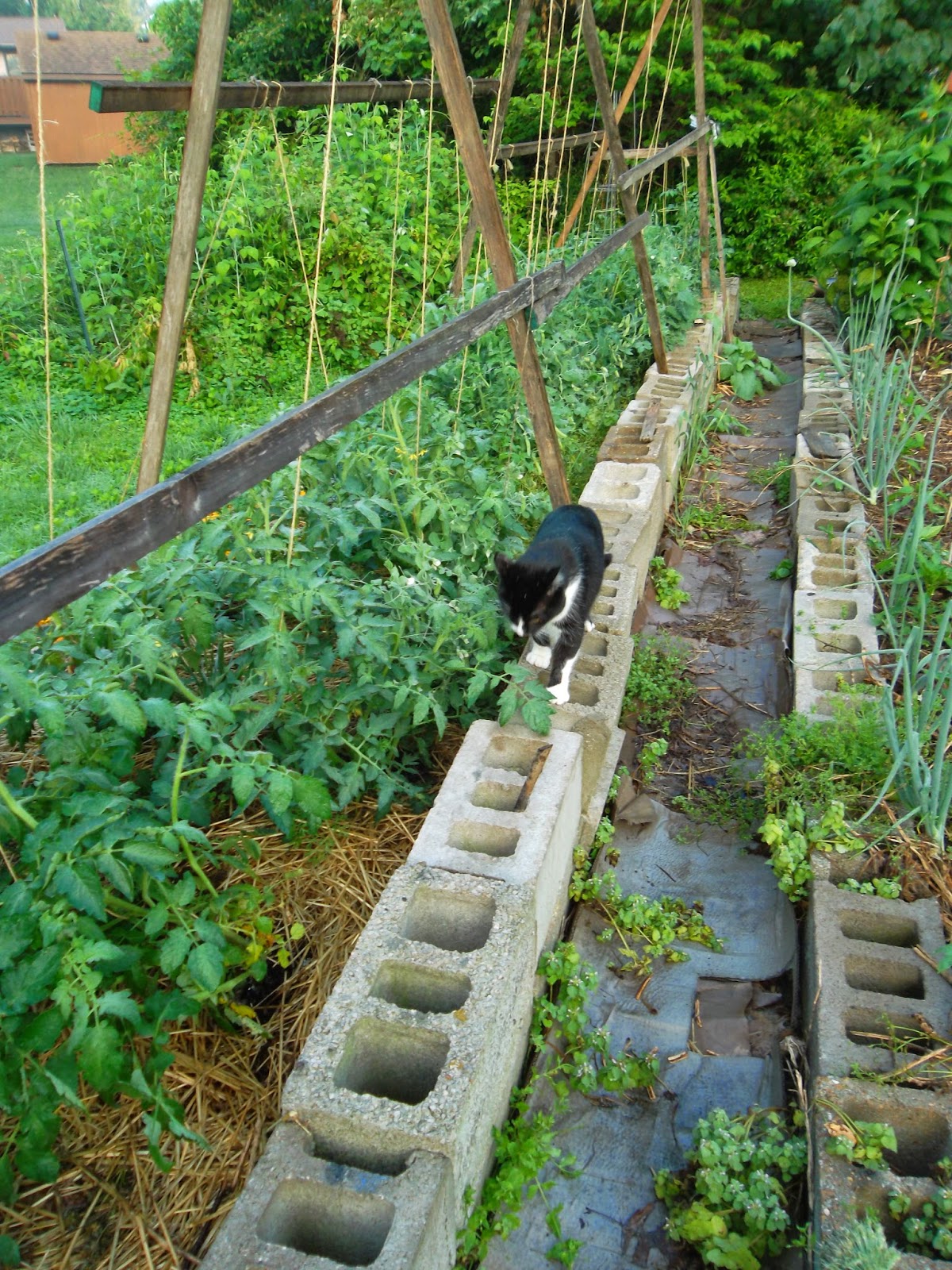
Smokey and the Tomato tepee. 
We had about 1/3 inch rain on Monday and the maters
took off. Had to rewind up with twine this morning and bring in more.

Smokey in the asparagus bed.
Still needs to be painted & screwed together.

Tomatoes & Marigolds

Happy June One.