Sunday, October 30, 2011

Chilies Out the Wazoo

I'm starting to feel like all I grow are chilies. I find myself searching the net for more chili recipes. I found this Pumpkin Ancho Mole sauce recipe on The Splendid Table here. They also have a very tempting Peanut Butter Stuffed Pickled Chili Pepper recipe I'm seriously considering for a T-givs appetizer. Here are preserved chilies 4 ways:
They are from L to R: dried Pasilla bajio, a salty spicy garlicy chili spread, Pickled Habaneros & Fermented Chili paste.

I'm really liking these Fish Peppers dried and crushed. Even the 7yr old puts them on her food. They have a great flavor and are a mix of cool colors.
Before drying. 

And after drying. Chili flakes are always on our table.

Ready for processing: habaneros, corno di toro and serranos. 

I'm ALMOST done harvesting all of the chilies for the season. I still have my Bhut Jolokia in the garden hoping they will turn before the frost, which is delayed so far. Here's today's catch:
A mix of late-harvested chilies.

Also dug today were my Georgia Jet Sweet Potatoes. I only had 3 plants, but got a nice crop out of them. I think I will grow this variety again next year. This is a 5gal. pot for reference. 

The fall garden is growing well. Here are some various crops- rutabaga, cabbage, turnips, brussel sprouts and other stuff I can't remember right now. 


The kale is of harvestable size now.

Fall Projects: I built this Passive Solar Heat Collector and hooked it up to my bathroom window. The day I built it was in the low-mid 80's and before I even hooked it up it was passing 110 degree heat out of it. It seems like I get around a 30 degree heat difference between the air T going in and what is coming out. Of course, it only really works on sunny days, but it is really neat to have FREE heat and the 7yr old already knows about cool air sinking and warm air rising, so it was a good science lesson too. The only bad thing to come of it is my infected finger (from a drilling incident). 

The Maple leaves turned and started falling very abruptly this week
Happy Autumn. Happy Halloween.

Tuesday, October 11, 2011

Overwintering Chilies and Free Food

It is so hard to pull a gorgeous, fruit-laden chili pepper plant from the ground. I kept telling myself and conveying to the poor peppers that it was for the best. Had to be done. The celestial clock is ticking and soon there will be no more impending frost. There will be frost. And death. Pull out a fat stack of plastic pots, a trowel and begin digging. I'm starting to think it may be best just to keep them pot-bound year-round. It is less work and they are still productive.
Mustard Habanero

Why overwinter chilies? 1. Starting chili pepper seeds in my cellar of a basement is difficult without bottom heat added and slow at best. 2. If I start several peppers each year I can chose 1 plant to keep of the bunch and have a small collection of various plants so I don't have to buy 20-30 seeds and start that many of each variety every year.  3. It is super easy. 4. I have the space and a dirty cellar basement to make a gardening mess in and 5. Overwintered plants will produce earlier than new starts and 6. Having life, aside from cave crickets and the pet toad, in the basement is oh so nice in the middle of winter. 

How do I overwinter chilies? Before the fall frost, which is due for us around the 2nd week in October chose which plants to overwinter. With a trowel make a cut into the ground in a circle around the chosen plant. Have a pot ready. Nicely yank the plant out of the ground and put it in the pot. Add some garden soil or potting soil to replace what just fell off. Water the heck out of them since you just tore off a lot of roots. Harvest all the chilies off of them if you haven't already done so and put a marker in the pot if you want to know what you have. After a couple of days adjusting to the pot trim the plant WAY back until it looks like some dead sticks. If you have room and don't mind cleaning up dead fallen leaves you can skip the trim. Put in the basement under a shoplight set to a timer.  Just water when the soil is dry. They won't need as much water as they will not have leaves to lose water from. If you do not trim them back and do not harvest the chilies you will have to water it more, but you will have peppers around the holidays. This is up to you. 
In the spring, bring the chilies outside slowly once the threat of frost is gone and allow them 1 hr of direct sunlight per day until fully acclimated. Now they can be planted back into the garden.

Chilies freshly dug from the Garden (and a bougainvillea) 

Other things going on today- I planted some more seeds. The chickens got through a hole in one of the hoop houses so I had to resew with lettuces, old spinach seeds and corn salad.

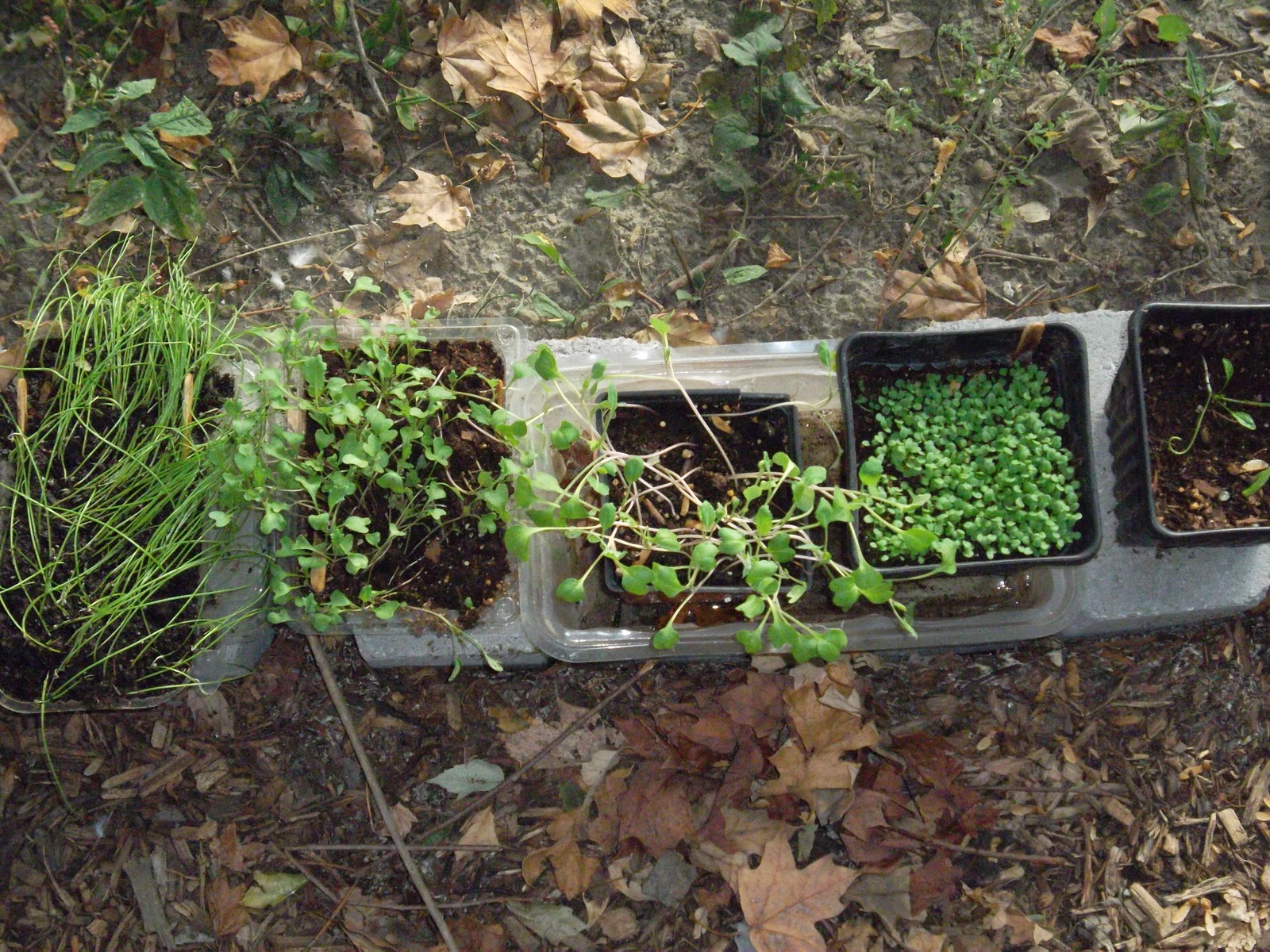
A few things I have started from seed in pots for the fall garden- cabbage, kale, green onions, spinach and johnny jump ups (for the heck of it).


What is the best kind of food? FREE FOOD!!! It is important to remember to mention to a fellow gardeners/foragers what vegetables/fruits/fungi you LOVE and do not grow well/find. For me, it is eggplant. I cannot grow it well without pesticides (although floating row cover may work, it just didn't last year due to the stray cat wanting to sleep on it) and I refuse to use them, but I still LOVE EGGPLANT. I came home yesterday to a huge bag full of eggplant at the back porch. Hell yes!  Thank you Jodee. While I've never had enough eggplant to try this I did today. Here's how I prepped eggplant for freezing. I plan on using it later for eggplant parmesan. 

1. Slice your eggplant while heating a large pot of water on the stove to boil. Directions said to add lemon juice to the water. My guess is that this is to preserve color, but who cares! It will be covered in tomato and cheese delight later. I did dump a few splashes of white wine vinegar and salt in the water for whatever reason. It seemed like a good idea. Blanch for 4-5 minutes. This breaks down the enzymes that would otherwise cause aging in the fruit.

2. Strain in a colander and set the hot eggplant in a bowl of ice-cold water to stop the cooking process. Strain again.
3. Lay them out on a cookie sheet and put in the freezer. Once frozen put in a labeled freezer bag. I read that they keep 8-10months. 

A fellow coworker is a hunter. While hunting she also forages for wild plant/fungal foods. She came across a huge chestnut tree. She gave me a bag of chestnuts. I gave her a bag of Slippery Jack bolete mushrooms. It was a free food trade. How awesome. I've never made my own chestnuts and she can't find Slippery Jacks. Whallah! 

Eating organic gourmet food, for next to nothing. Life is good.


Thursday, October 6, 2011

Taking in the End

Now is the time to take in the view as shortly it will all be gone. Flowers, colorful leaves, seed heads black with promises, greenery. In one fell swoop the killing frost will steal our color palette leaving us with browns and grays for the long winter. No more blue sky morning glories with sleeping bumbles.
No more lustful aroma of the come hither Snail Vine.

No more red. No more red tomatoes to be eaten in the yard. No more figs full of sweetness.

Time to collect the Amaranth. Time to make pesto. 

Enjoy. Enjoy. Enjoy and prepare. I've started some new beds of various plans. I have 2 beds in the orchard dedicated to Winter Rye. Between the shade of the orchard trees, the dogs and the chickens all of the grass is gone. I'm not necessarily sad. The Winter Rye will have many roles. 1. It is a green manure so I've planted an oval bed around 3 fruit trees so in spring the greens can be turned into the soil and nourish the fruit trees. 2. The greens will either be eaten as much needed greens by the chickens in the spring/late winter or if having gone to seed. Either way, it is a cheap and nourishing food for the chickens as well. 3. Something we don't tend to think about is that plants are part of the food web for underground life (beneficial bacteria, fungi, invertebrate soil life) and having greenery above ground means there is food or habitat below ground. This may be one of our major mistakes in agriculture- leaving a field fallow. What happens to the soil life when there is no green above? Where do we ever seen fallow land in nature? Perhaps after a flood or volcano, but this doesn't last long. Nature abhors a vacuum. I'm amending the soil and thereby the life below. Feed your soil. I'm also running an experiment as one rye bed will be covered with plastic and the other not. Here is the one that will not be covered:
Two other beds (one with burlap, the other with plastic) will be for winter crops- carrots and mixed greens. I made these super cheap and easy hoop houses out of plastic conduit. The purpose of the burlap is just to keep the chickens out for now.
Other things I need to do is establish a given spot for my new vegetable- the potato onion (also called multiplier onions). Since I eat onions on a daily basis and because once established I will never have to buy them again (talk about cheap food) I need to prepare the perfect bed for them. I ordered them from Territorial Seeds. You can't find these just everywhere. I'm not sure why they are such a secret, but I suspect the older generation is more than aware of their existence. They are defined as having a more gourmet flavor, much like shallots, which I love so I'm looking forward to the first harvest. This is what they look like:

Since it is my blog, I suppose I can deviate away from strictly gardening and talk about wild foraging too. My Aunt Kathy found these mushrooms and gave them to me. They are called Slippery Jack because of the slimy coating on the cap. They grow under evergreens and apparently my grandparents use to eat them. These shrooms are in the bolete family. Instead of gills they are polypored underneath. I'm thinking about a mushroom barley soup tonight. These guys are a little dry, but I have fresher ones and these will rehydrate easily.


A few more pictorial documents below of life in the garden in early October: 
Baby Kale coming up.

Cotton plant! Just for something fun.

One of my assistant soil preppers- Scarlet.

That is all for today. Must get out and enjoy this ridiculously gorgeous weather we've had for weeks on end now. 

Tuesday, September 27, 2011

Fall: Gathering, Bringing Indoors & Cooking

We are having the most lovely fall days in the 70's. There is nothing to complain about when you look at a forecast that says everyday will be 70 for the entire week! The Bur Oak has begun dropping its leaves.  A few dogwood leaves are reddening. A pile of buckeyes lay on my kitchen table squirreled by some little person in my house. Carrots, kale, spinach, rutabaga, lettuce, green onions and leafing cabbages are sprouting in the fall garden.  I use to wait until the last possible moment when threatened by an overnight killing frost to bring in all of my houseplants and such. Not anymore. It's too much. I get crazy. So that project started today. The succulents and cacti come back to their windowsill residences. The lusher houseplants find their old stands. Annuals of various sorts (begonia, avocado, coleus, sweet potato vines, bromeliads, chili peppers, tender salvia, elephant ears, plectranthus, etc)  move into the basement to eek out a poor existence under shop lights. Such is life. Some days you have sunshine and others not.

Agaves, Jade, Hobbit Fingers Jade, Mother of Many in the window.

I also collected more annual seeds from things I hadn't yet: marigolds, petunia, celosia, gomphrena, star zinnia, purple prince zinnia. I make little paper packets for the smaller seeds, reuse envelopes, jars, old medicine bottles and lunch bags for others. 
After letting them dry a bit they will be contained & labeled. 

So, I've read about and watched youtube videos about Window Farming. The idea is growing some of your own food, in windows, in urban areas, hydroponically. I was trying to think of why you would want to do it hydroponically (that is, with a nutrient solution/soilless) and the only benefit I can see is less mess (unless you spill the solution). With hydroponics you have to check to make sure you are maintaining a proper pH and nutrient balance. Soil can certainly lose nutrients with use and either way the plants will show you this. So, I was considering trying it out using 2 liter bottles, but with soil. I had two mismatched bottles (mistake number 1), but thought I could still configure a way to stack them, which I did, but the hole on the bottom of the top one didn't fit perfectly with the bottom and so leaked, but not necessarily into the bottom one, which is the point. I'm not giving up on the idea. The have soil and seeds (mesclun mix and wild basil) and are growing so far so....look for updates. Oh, and for now, I've separated the two bottles until I'm ready to do more upgrades. Here are the bottles:
The plants are suppose to grow out of the cut out parts of the bottles.

Cooler weather also makes me want to cook and cook comfort food. A friend turned me on to this book:
I've really gotten into it. I learned a lot of stuff I didn't know about how to make a good veggie burger, french fries in the oven and homemade buns. Attempt #1: Easy Bean Burger, Spicy Fries and Whole Wheat buns turned out divine. Here they are:
Good buns.

Easy Bean Burgers with red beans pre-cooked.

All together now. Yum.

Now, I wish I could say most of the ingredients came from my garden, but only the parsley and potatoes were locally grown. Although, I am growing winter wheat, but for a green manure/chicken food. I continue to experiment my way through this cook book. Tonight is falafel burger night. 


Monday, September 12, 2011

Winding Down or In?

Not surprisingly I'm getting ready for bed about the time the sun is too. I'm fading with the Caladiums. I can't deny the circadian rhythm inside of me. I also start squirreling this time of year. Shorter days lead to more time to think, create and plan. So, what do I want to do next year? What improvements? What investigations do I want to carry out? Well, let's start with the actual events. The potted Caladiums are still doing well, but the in-ground ones have decided to call it quits with the drought. So...time to pull 'em up. Make sure to nab these before you can't recognize where they were. The leaves decompose very quickly. I started pulling them this weekend. I wait until the leaves are browning and I know the bulbs are storage-ready. I have 4 different varieties and started sorting them into separate pots for now. Later I will properly bundle them up for winter in the basement.
All is still well with this lovely gem. 

This is also the time to take cuttings for overwintering plants you won't dig up and will not survive winter outside. For me this includes: coleus, begonias, persian shield, plectranthus, geraniums and possibly some herbs, like favorite basils or mints. 
This plant was new for me this year and it had some obscure common name (no scientific), but I decided it was a keeper for my back patio hot-tropical gem-tone theme. 

It's also time to collect seeds. I've chopped all the heads off my Joe-Pye Weed. I have gorilla gardening plans to disperse this along a road leading into my hometown.  Leaving my legacy? Below is a million Brown-Eyed Susan heads ready for collecting.


Speaking of collecting...for the first time I decided to collect some lettuce seeds from some wonderful lettuce I grew this year. Specifically, I fell in love with Winter Density. It is a cos-type. When the flowers had turned to parachute-filled heads (like a dandelion) I cut them, hung them upside down in a paper bag and stored them in the coat closet until today. I have a flower bed along the south side of my house that does nothing all winter. So, I chopped up the seed heads, tried my best to rub the seeds out (not sure about this technique) and sprinkled them all over the mulch and watered well. If I get lettuce there- hurrah! If not, I've learned what not to do. 

Other good activities this time of year- buy cheap plants. You can put them in now, water well so they take root and don't frost-heave on you or overwinter in a protected place outdoors or in the basement. Here are some recent purchases, some of which are already in the ground.
A wispy hosta and some lime ajuga. 

I didn't think I liked begonias until I realized (because mom gave me some free ones last year) that they are incredibly easy to grow in very difficult places. So, I got these at Wally-world for $1.50. They will easily overwinter in my basement and I save $ next spring.
It doesn't matter how pathetic they look now. They will flourish next year!

And now for an unplanned, although desirable garden project. It seems my chickens overstayed their welcome in the hood and got the po-po called on them for trespassing. So....they are confined for good (or at least until that neighbor moves). wink. I built this trellis gate to keep them in their yard, which has worked so far, although I don't think they are in love with the idea. 

And lastly, I leave you with this. I was fortunate to have had the opportunity to spend 2 months in Africa. I feel even more fortunate that I was there on 9/11. Why? I didn't have a television, nor internet and only a radio through which I could gain the perspective of people a half a world away from the US. I found myself turning off the radio here every time 9/11 was mentioned this week. I don't want to think about it. I don't want to relive it. I don't want to see the images that played over and over and over on the TV here. What I do want is for us to move on and learn in a way that we have a hard time doing here. I had sent myself a postcard from Africa of what was important to me then. A reminder. The same things are still important to me. I love the picture on this card and I love the message I told myself. It is personal so I won't air it all here, but if you really know me you know that there are many things I find unimportant in this life and an equal number opposite. Obviously, gardening, eating good stuff and being self-reliant are some of those things. I keep this in mind as I continue on my path of learning and in this time of reflection and winding down for the slow season. 
Gorgeous.

Tuesday, August 16, 2011

Putting Up or Putting By- Canning & Dehydrating

The worst part about the "putting up" season is that it is usually the hottest time of the year and slaving over a hot water bath isn't the greatest of pleasures, but the product is. I'm sure that if I thought about all the time I put into making something, like salsa, it alone would not be worth the cost versus going to Walmart and buying a jar of it, but since I'm paid nothing it ends up being cheaper to make my own. Then there are things to consider: the migrant farmers who get paid crap, while being sprayed with pesticides, the picking of unripe fruit to travel across the country to my local store where someone with E. coli touches the fruit and it spreads all over everything, etc. Even if none of this were true I'd still want to make my own because 1) it's better 2) I did it all by myself (which has pretty much been my mantra since I took my first breath (by myself).

So it is that time and I'm happy to say after a grueling summer we are in the low 80's and I've never been in more of a mood to put by some food. Today started with dehydrating some green beans, which were past their prime and a load of Thai Basil. I LOVE thai basil and I can only get it fresh in the winter at Jay International grocery in St Louis, which I don't get to enough since leaving my job in the city. Oh well. Dried is pretty decent. Since my tomato crop is dismal I had to BUY (ugh) tomatoes at the local farm. Oh well, they are local at least. So, salsa is going to be a smidge more expensive this year. I figured it ran me $1.07 per jar. 8 quarts of tomatoes, 6 red onions and 28 Fish peppers yielded 12 pints and 2 quarts. I followed a new recipe this year, which called for ground cumin seed, but I put it in whole. I'm always on a quest for a better canned salsa recipe. But nothing beats fresh. I also am trying a new hot sauce recipe, which calls for a mash of chilies to be fermented for 4-5 weeks. It better work, because I cleaned the garden and put every chili I had into it and including some sweet varieties: Bulgarian Carrot, Fish, Mustard Habanero, Corno di toro, Hot Portugal, Sweet Cherries, Jimmy Nardello frying peppers, Pasillas. Ground them all up and salted the heck out of them and put them in under glass to ferment. I'm using the directions in the August/September issue of Mother Earth News. I'm not sure if a link is up yet, so here's a pic of the recipe:


Chilies pre-chop.

Chilies chopped, salted, covered with cheesecloth and weighted with a plate to ferment.

The latest canned salsa recipe said to salt and allow to drain the tomatoes, which sounded like a good idea since my canned salsas tend to come out to watery. The salt drained away with the juice so I ended up having to add more to the recipe. Here are the maters salted and draining and stuff dehydrating. This is what 8 quarts of chopped roma tomatoes looks like. You need a large stock pot to cook this in.

I hired this small migrant worker to pick the Fish peppers for the salsa. The recipe called for a pound of chilies, but knowing that I would be feeding it to said migrant worker I only used 28, which I figured would be about 2 chilies per jar. It is between mild and medium hot. 

Here are the gorgeous Fish peppers. The plant is variegated and the chilies are a rainbow of striped colors. I just love the way they look.

End product:

The small migrant worker has requested lunch made from home this school year so I'm making lots of peach jam, as I figure PB and Jam are going to be my go-to quick sandwich many of days. A 1/2 peck of peaches yielded 11 jars of jam or 59 cents per jar. I decided to cover my butt I'll make another batch. 

Since we're talking food, I struggle with this idea of cost of food, food stamps, eating poor in poor communities, lack of access to healthy food, etc. I'm just not totally convinced that you can't find a way to get healthier food and I AM convinced that eating cheap food will make you pay for expensive medicine later. Some people in urban areas are using abandoned lots to grow gardens. You can grow a tomato in a bucket you find on the side of the road. I have. This is what $25.00 in fresh, locally grown food looks like: 

Making and eating salsa is an unnecessary pleasure, but I could have easily used some of the same ingredients and made pasta sauce and at a cost of $1.07 per jar that beats any dollar store. It would have cost pennies if my own tomatoes had produced better. My jam costs under $1.00 per jar too. Neither are high in protein, but that is where peanut butter steps in. It's a cheap protein or I could use my salsa to add to beans and rice, which make a complete protein. It isn't a stretch for me to eat cheap. I think more people could do it. 


Tuesday, August 9, 2011

Taming the Wild

I put a lot of thought into my garden and I think at least 30% of it has failed me this season. All of this loss makes me wonder what successes I have had. What should I repeat and learn from? One of the things I thought about was growing greens all summer long. I've tried a lot of knew things. The amaranth, while successful in germination, ended up being devoured by bugs. A few made it (survival of the fittest), but then I didn't eat it because I want to collect the seed, which is fine, because it is pretty and I want the ones with the "good" genes anyway. The climbing spinach worked, although it was choked out by the other climbers I planted with it. I had a few Perpetual Spinach germinate and look ok, but I think they are waiting for cooler times to step it up. Stepping back and taking in the panoramic of the garden what I see is these gigantic lamb's quarter shrubs that I didn't plant. They are loaded with healthy greens. As a matter of fact they are healthier than most of the plants I purposefully planted. There is barely any bug damage and they can be harvested perpetually throughout the summer. Hmmmm. Think I could learn something from this plant that has spent a couple hundred of years adapting to this environment? Insert big duh here. I love lamb's quarter. I eat it whenever I can. I never plant it. It requires no water, fertilizer or pesticide. DUH! My latest take on lamb's quarter is the taming of it in phyllo dough triangles. I sauteed a huge bowl of it with a shallot, some garlic and salt and pepper and tossed it in a blender to chop. I mixed in a little Bulgarian Feta and folded these little pockets up and baked at 350 for about 18 minutes. Yum. They were even good for breakfast this morning!
My mom, brother and I often debate the "healthiest" food. I'm convinced this should be the winner. Check out the nutrient content here.  It has a low glycemic index, high anti-inflammatory properties, high protein value, high nutrient balance, over 1,000% Vitamin K, 281% Vitamin A and other vitamins and is high in calcium and other minerals. How can you go wrong? I love it more than spinach. In fact, it blows my mind that this isn't a mainstream crop. Just look at how easy it is to grow and it wouldn't have to be shipped in from outside of the midwest! Incredible. Not only will I let this go to seed I think I will collect it and grow more of it next year. Another noteworthy comment is that it grows in nearly all of Europe, where my closest ancestors likely ate it too. If they survived and ate this wild crop, surely there is a reason to continue eating it (not that I will be passing along my genes to anyone).

Another success of the year: tomatillos. They thrived while my tomatoes suffered. 
Into the blender with a chili and some onion. Raw Salsa Verde.
And...
But even better was when I roasted the ingredients and then blended them together for Salsa Verde #2. Tomas impart a somewhat gelatinous texture to the salsa, like a thickener. It was good and different. I would grow them again. Now, I need a canned recipe to put some up for winter.

So what else- any surprise that a native fruit is more successful than ANY other fruit I've ever purchased and planted? Ya, so the orchard has had so many failures that I'm giving up on things. I'm not replanting. Any tree that dies isn't getting replaced. I will simple put in raised beds and fill it with something useful. I've been collected Wild Plums from trees I planted when I moved in about 10yrs ago. The produce loads of sour-skinned little fruits that I traditionally do nothing with. The bees of many sorts love the flowers and the butterflies come to the dropped fruits. This year I am collecting, seeding and freezing them until I have enough stored to make WINE! Yes, wine. My newest of hobbies. The fruit doesn't all drop at once, which is why I'm freezing it. I've also read that it takes 3 years to develop the best flavor. Wow. I certainly hope I don't F it up!
These are about the size of bing cherries.

My paltry tomato crop has yielded this much in canned tomato sauce:
Made of mostly Orange Icicle and Juane Flamme tomatoes.

Things that have failed or done lousy include: zucchini and yellow squash, cantaloupe and the tomatoes look like crap. I need to take this in and look to nature. What do I need to change? Obviously native plants or weeds are successful. Will I keep trying? Of course, but I have started the chopping block this year. Time to stop investing in an uphill battle and plant high-producing, dependable and self-sufficient crops. Look to a native plant to answer my questions:                Native Hibiscus
Grow where you are planted.